
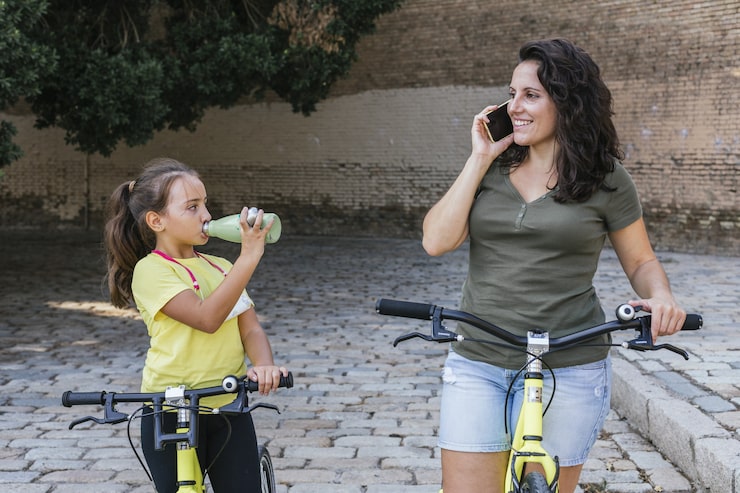
Today’s post looks at the financial and developmental perks of raising free-range kids. Now, where did those two rugrats run off to?
While enjoying the scenery up here in northern Michigan, I dug into Lenore Skenazy’s bestselling book from 2009. Halfway through, the message is clear: parents have gotten wildly anxious about letting kids roam on their own, even though, statistically, we’re about as safe now as we were in the early 1960s.
The book is an easy read full of funny stories. That’s not to downplay real child abductions—they’re tragic. But this isn’t a how-to guide for letting kids wander without thought. It’s a call to use common sense in a world that overreacts because of the 24-hour news cycle.
If you’re aiming for early retirement, remember the point is freedom—the freedom to get out and enjoy life. It would be pretty ironic to pursue financial freedom while keeping your kid “on a leash.”
Skenazy’s tales of moms flipping out when their kids grab an ice cream or see a movie unsupervised (my description!) brought back my own childhood. I was as free-range as they come. Growing up in rust-belt Michigan in the 70s and 80s, freedom for kids was normal.
By age five I was walking three blocks to school. I biked to friends’ houses, the park, or the local 7-11. Summers meant biking everywhere or playing in the yard. If a babysitter showed up, she was probably inside chain-smoking on the couch.
Later I walked or biked two miles to junior high—terrible in winter, let me tell you. Going to movies or on dates was no big deal; parents would drop us off and pick us up a few hours later. By high school I had an 11 PM curfew and a car to drive to the next town—where I could meet girls who didn’t know what a dork I’d been in school. Not planned, just worked out pretty well.
Beyond the obvious reasons to let kids be kids, there are financial benefits too, though I don’t put the money first. The main idea is to let kids explore without constant supervision and a calendar full of structured activities.
Think about those activities. Do you drive Junior to guitar lessons? Are those lessons even necessary if he isn’t interested? That’s worth asking—Gershwin didn’t see a piano until he was 12, the author points out.
What about the cost of always chaperoning your child and their friends? That’s opportunity cost. Could you be working a side hustle while Junior pedals off to play with his Huffy? I think so.
The biggest cost is raising fragile kids. Skenazy shares college professors’ complaints about increasingly delicate students arriving on campus: great SAT scores, but not much resilience. They might struggle just getting across Manhattan without freaking out.
Did the movie Home Alone scare every sensible parent in America? Thanks for that, John Hughes!
Stats back this up: we’re about as safe as we were in the early 60s. A child is far more likely to die in a car crash than to be abducted from the street. Rates of serious crime and sexual assault against kids have fallen dramatically since the early 90s. Everyone has a phone now and can call for help. Better yet, kids who learn independence are often better at handling rare dangerous situations.
It’s the same idea as being more likely to be struck by lightning than killed in a terrorist attack. But watch the news all day and your brain gets wired to panic. The media feeds that fear.
Then there’s the booming market for child safety gear. You can spend a small fortune baby-proofing every corner—locks for toilets, outlet covers, corner cushions. We mostly got by without much of that. We did use outlet plugs, mainly for insulation.
When you see all these products, ask whether one big incident triggered the hysteria. Life has bumps and bruises. There will be injuries and close calls. But if you overprotect your kids, they won’t learn why you’re working for financial freedom. It sure isn’t to sit inside watching TV all day. I’m not trying to shame anyone—just offering something to think about.
What do you think of this idea?